Munich is Germany’s most expensive and most productive retail location. With retail-relevant purchasing power 30 per cent above the national average, the highest floor productivity of all German inner cities and by some distance Germany’s most expensive highstreet, the Bavarian capital is the prestige target of every retail expansion. Kaufingerstraße records some of Europe’s highest pedestrian frequencies, while Maximilianstraße concentrates the international luxury segment. UNIQUE RETAIL advises nationwide with a specialised focus on retail and supports owners, investors and tenants in Munich’s prime locations and centre standorts.
Market data: as of July 2026
Munich as a retail location in figures
The basis of the Munich retail market is exceptional. Retail-relevant purchasing power stands at an index of 130.0 – the highest value among German cities. Retail centrality is 114.7, fashion centrality even 222.8 – Munich leads the national ranking here too. Annual turnover of Munich retail stands at around 11.1 billion euros and is thus on a level with Hamburg. Noteworthy is the inner-city share: with around 3.3 billion euros, about 30 per cent of total city turnover falls on the inner city – the highest inner-city share of all German top-7 locations.
The inner city covers around 494,000 square metres of retail floor and reaches a floor productivity of about 6,800 euros per square metre – the highest value in Germany. This exceptional productivity is an expression of strong local purchasing power, a high tourist share, an exceptionally dense and sought-after inner-city structure, and particularly high pedestrian frequency. The catchment area comprises around 3.2 million consumers in the city and surroundings.
Munich’s prime highstreet locations
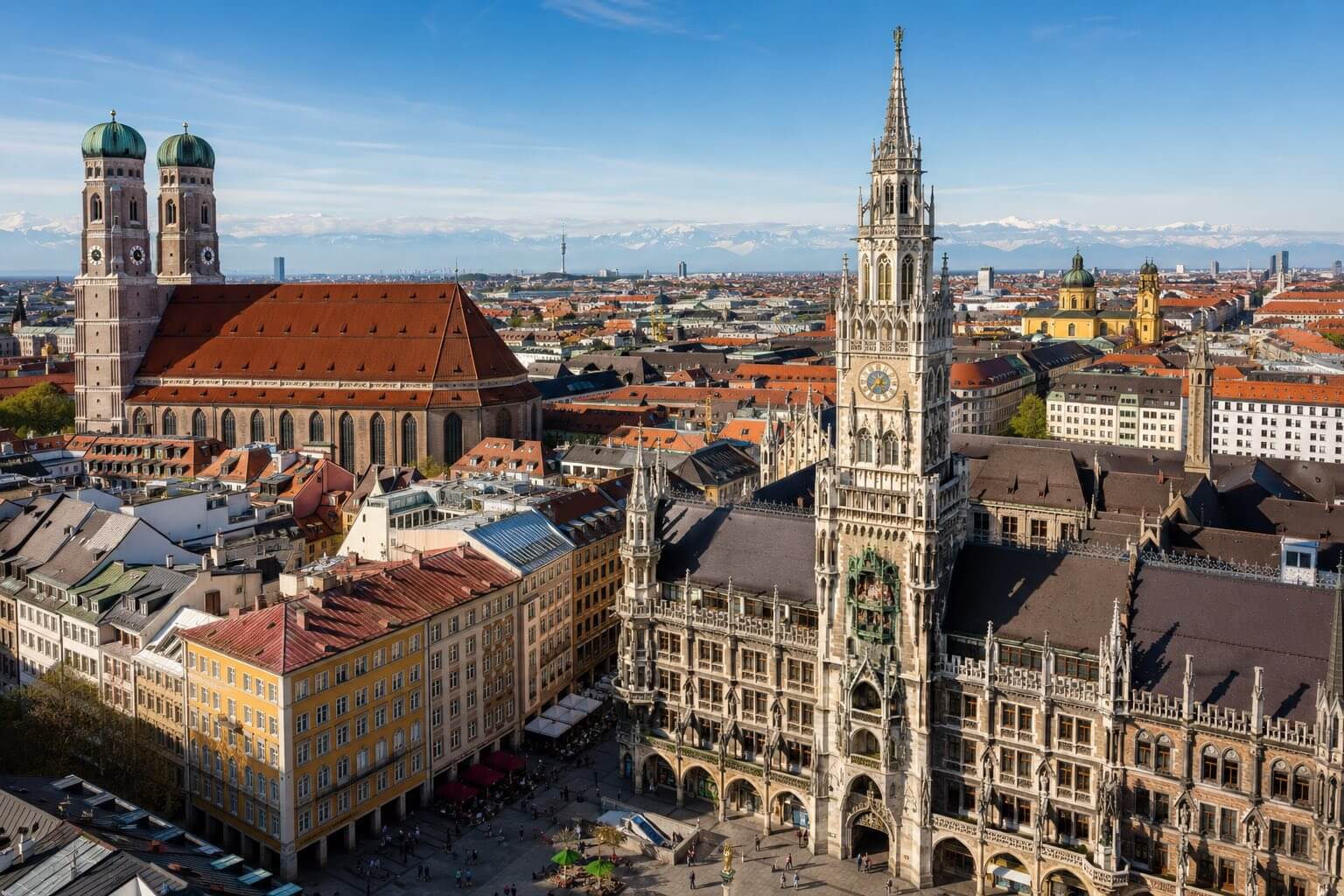
Munich’s inner city is characterised by a particularly clear structure: mass-market and luxury retail lie only a few hundred metres apart, without overlapping. The central retail axis Kaufingerstraße/Neuhauser Straße runs between Marienplatz and Karlsplatz. The luxury boulevard Maximilianstraße reaches from the National Theatre to the Isar. These axes are supplemented by Theatinerstraße, Sendlinger Straße and the upscale Fünf Höfe arcade.
Kaufingerstraße and Neuhauser Straße – Europe’s most frequented retail street
The axis Kaufingerstraße/Neuhauser Straße is regularly rated among Europe’s most frequented pedestrian zones. Peak values of well over 10,000 pedestrians per hour are common here. On the approximately 700-metre-long stretch, major multiples (Zara, H&M, Uniqlo, C&A, Primark, Galeria Kaufhof, Sport Scheck), modern verticals (Weekday, Massimo Dutti) and international retailers line up next to each other. The prime rent on Kaufingerstraße stands in Q1 2026 at around 340 euros per square metre per month – Germany’s highest value and unchanged year-on-year. For retailers with scale benefits, this axis is despite the high rents one of the world’s most rewarding locations, because turnover is correspondingly high.
Maximilianstraße – the classic luxury boulevard
Maximilianstraße is Munich’s classic luxury address. Louis Vuitton, Chanel, Dior, Hermès, Prada, Gucci, Bulgari, Cartier – the full line-up of international luxury brands is represented with prominent facades. Unlike Kurfürstendamm in Berlin, Maximilianstraße runs both compact and generous – the representative street width and the sightline towards the National Theatre underline the prestige character. Rents lie at a high level, but behind Kaufingerstraße – luxury retail in Munich pays not for frequency but for surroundings, target group and address prestige.
Theatinerstraße – premium with arcade connection
Theatinerstraße connects Odeonsplatz and Marienplatz and positions itself as a premium boulevard between the mass-market highstreet and the luxury segment. Brands such as Louis Vuitton (flagship store at the end of the street), Bulgari, Fürst and modern premium verticals shape the tenant mix. The adjacent Fünf Höfe – a high-quality arcade quarter – extend the premium axis by additional small-scale space and concept stores.
Sendlinger Straße – urban, young brands
Sendlinger Straße between Marienplatz and Sendlinger Tor is increasingly developing into an address for younger brands, upscale streetwear, concept stores and modern gastronomy. It is an important complement to the multiples carpet of Kaufingerstraße and offers retailers with differentiated concepts an alternative to the mass-market prime locations.
Prime rents Munich 2026 – stable top at 340 euros per square metre
Munich’s prime rent on Kaufingerstraße has been unchanged for several quarters at 340 euros per square metre per month. Munich is thus by some margin Germany’s most expensive highstreet – Berlin and Düsseldorf follow at 290 euros each. The 50-euro gap is structural and reflects the unique combination of highest purchasing power, highest pedestrian frequency and highest floor productivity. For retailers, Kaufingerstraße remains the prestige location par excellence. After the correction phase 2020–2023, the market has stabilised here particularly quickly.
Investment market and prime yields
Munich’s investment market for retail properties is characterised by chronically limited supply and strong demand. Prime yields for highstreet objects in absolute top locations stand in 2025/2026 at around 3.7 to 3.9 per cent. For core investors – particularly for long-term-oriented family offices and institutional investors – Munich is Germany’s most prestigious retail investment location. The limited number of tradable objects in absolute prime locations leads to long holding periods and rarely realised transactions. When objects come to market, very tight bidder groups with international participation often form.
Purchasing power, catchment area and tourism
Munich attracts a catchment area of around 3.2 million people – not the largest reach among the top-7, but the strongest in purchasing power. The exceptionally strong economy (BMW, Siemens, Allianz, Munich Re, HypoVereinsbank, major tech locations) and the high number of high-income employees make Munich Germany’s strongest consumer market by purchasing power. Tourism delivers a significant additional layer of purchasing power – Munich records around 17 million overnight stays per year. Particularly international visitors from the Middle East, Asia and the USA are relevant for luxury retail on Maximilianstraße.
Current developments and projects
Several large-scale projects shape the coming years of Munich’s retail landscape:
- Alte Akademie – mixed-use new development in the Karlsplatz environment, repositioning of one of the most prominent inner-city objects.
- Karstadt am Bahnhofplatz – after the insolvency of the Signa Group, structural realignment.
- Kaufhof am Marienplatz – ongoing concept discussion and possible restructuring.
- Fünf Höfe / Pfisterstraße – continuous upgrading and densification.
- Werksviertel and Ostbahnhof environment – new retail and gastronomy concepts outside the historic inner city.
What this means for owners and investors
Munich remains the prestige target of every retail investment strategy in Germany. For owners, the combination of high tenant quality and flexible concepts for lagging cycles is decisive. For investors, the market offers less volume, but outstanding location quality – whoever acquires a top location in Munich buys into an exceptionally robust segment. UNIQUE RETAIL supports owners and investors in Munich in letting, acquisition and repositioning of retail properties with reliable market data and an active retailer network.
UNIQUE RETAIL for Munich
You own, develop or are looking for retail space in Munich? You are evaluating a retail property investment in the Bavarian capital? Talk to us – we will provide an independent assessment of market value, lettability and repositioning potential.
Request a free initial consultation →
References & further analysis
Frequently asked questions on retail properties in Munich
How high are the prime rents in Munich?
The prime rent on Kaufingerstraße stands in the first quarter of 2026 at around 340 euros per square metre per month (net cold) and is thus the highest in Germany. Berlin and Düsseldorf follow at around 290 euros each. Munich’s prime rent has been unchanged for several quarters.
Which are the most important prime locations in Munich?
The central mass-market highstreet is formed by Kaufingerstraße and Neuhauser Straße between Marienplatz and Karlsplatz. The luxury boulevard is Maximilianstraße. These are supplemented by Theatinerstraße (premium), Sendlinger Straße (young brands) and the upscale Fünf Höfe.
How high is purchasing power in Munich?
Retail-relevant purchasing power in Munich stands at an index of 130 and thus 30 per cent above the national average – the highest value of all German cities. Fashion centrality of 222.8 is likewise the highest in Germany.
Why is Munich so expensive for retailers?
Munich combines the highest purchasing power, highest pedestrian frequency and highest floor productivity of all German cities. Kaufingerstraße is rated among Europe’s most frequented pedestrian zones. For retailers with scalable concepts, turnover per square metre is exceptionally high despite the high rent.
What does the retail property investment market in Munich look like?
Munich’s investment market is characterised by chronically limited supply and strong demand. Prime yields stand in 2025/2026 at around 3.7 to 3.9 per cent. Prime location objects rarely come to market and attract an international bidder group when sold.