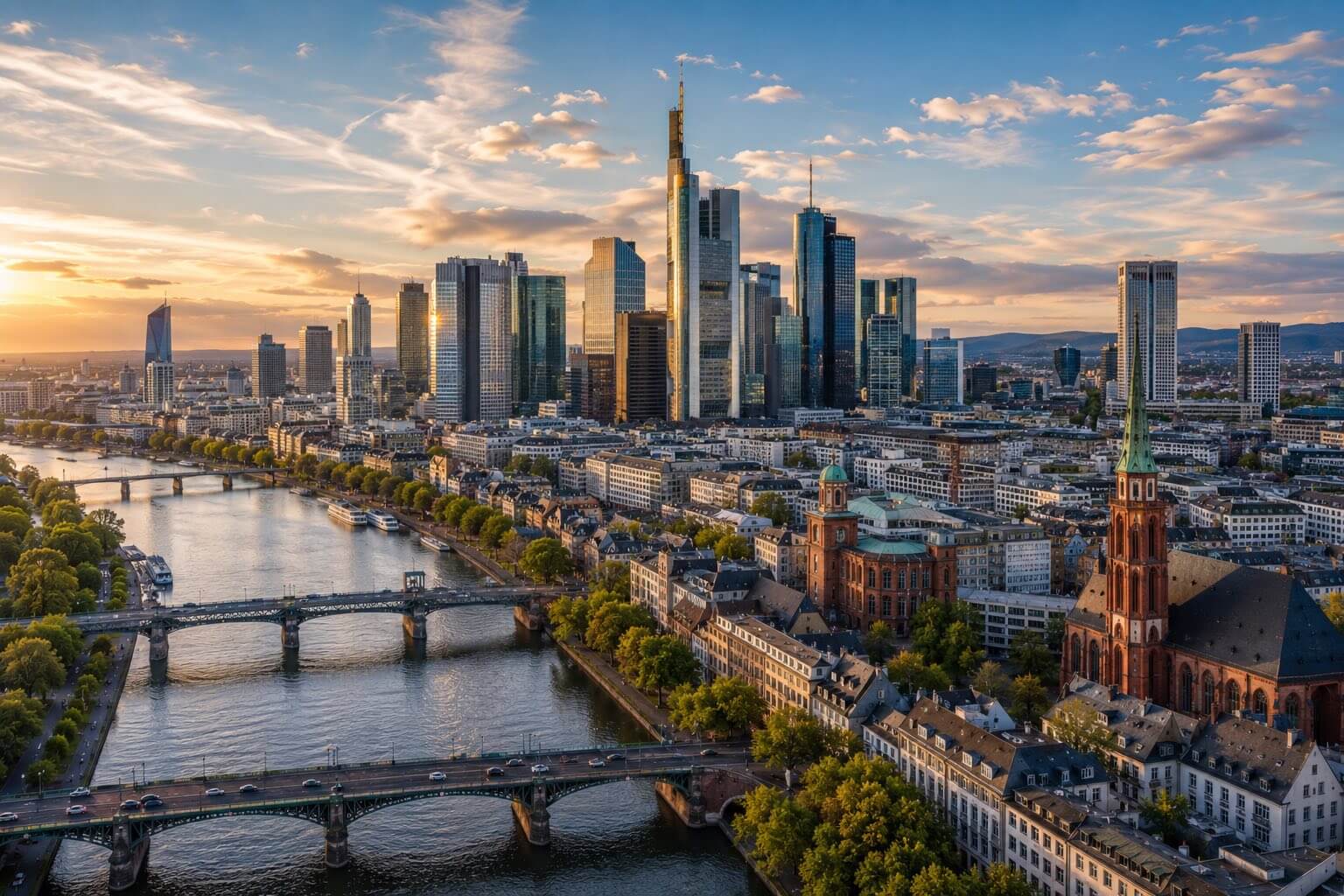
Frankfurt am Main is Germany’s most international retail location alongside Berlin and Düsseldorf. As a financial metropolis and Germany’s most important international aviation hub, Frankfurt attracts an exceptionally international customer base. The Zeil is one of Germany’s most frequented pedestrian zones, Goethestraße counts as the most compact luxury boulevard with one of the highest turnovers per square metre in Europe. With around 770,000 inhabitants and a catchment area of about 2.4 million people, Frankfurt is by population the smallest top-7 location – measured by purchasing power and international appeal, however, one of the strongest. UNIQUE RETAIL advises nationwide with a specialised focus on retail and supports owners, investors and tenants in Frankfurt’s prime locations.
Market data: as of July 2026
Frankfurt as a retail location in figures
Frankfurt’s retail market benefits from above-average purchasing power. The index stands at 114.3 – after Munich and Düsseldorf one of the top-3 values. Retail centrality is 103.5 – the lowest value of the top-7. This is mainly due to purchasing-power outflows into the surroundings (the Frankfurt Rhine-Main region is densely populated and highly competitive). Fashion centrality of 205.1 is nevertheless high and shows the trans-regional appeal of Frankfurt’s inner city for fashion buyers.
Annual turnover of Frankfurt retail stands at around 4.4 billion euros. The inner city covers around 281,000 square metres of retail floor and generates around 1.46 billion euros of turnover – around 33 per cent of total city turnover. The inner-city floor productivity of about 5,200 euros per square metre lies above the national average and reflects strong demand from business customers, international travellers and surrounding-area residents.
Frankfurt’s prime highstreet locations
Frankfurt is characterised by an unusually clear two-axis structure: the mass-market highstreet Zeil and the luxury boulevard Goethestraße, connected by the Fressgass as gastronomy and premium axis. This densification in a small area makes Frankfurt’s inner city structurally special and creates clear location decisions for retailers.
Zeil – the mass-market highstreet with record frequency
The Zeil ranks among Germany’s most frequented pedestrian zones. Around the Hauptwache and in the direction of Konstablerwache, Zara, H&M, Uniqlo, Galeria, Primark, Peek & Cloppenburg, Media Markt, Saturn, Zara Home, Weekday, Massimo Dutti and many other multiples line up next to each other. The MyZeil centre and the Zeilgalerie complement the open pedestrian zone with covered retail floors. The prime rent on the Zeil stands in early 2026 at around 285 euros per square metre per month and is thus on a similar level to Tauentzien in Berlin and Königsallee in Düsseldorf. For retailers with scalable concepts, the Zeil is one of the most important German locations.
Goethestraße – the compact luxury boulevard
Goethestraße counts as one of Germany’s most expensive luxury addresses. On only about 400 metres in length, Louis Vuitton, Chanel, Dior, Hermès, Cartier, Bulgari, Gucci, Prada, Bottega Veneta and many other international luxury brands concentrate. Despite the short length, Goethestraße counts through the extremely high densification of luxury brands among Europe’s most turnover-strong luxury addresses per square metre. The customer base consists disproportionately of business travellers and international guests – Frankfurt Airport as Germany’s largest delivers the corresponding frequency.
Fressgass – gastronomy plus premium retail
The Fressgass (Kalbächer Gasse and Große Bockenheimer Straße) connects Zeil and Opernplatz and is Frankfurt’s traditional gastronomy street. In recent years, the Fressgass has increasingly profiled itself as a premium retail location with many concept stores, high-quality gastronomy and boutique brands. It is an important complement to the mass-market focus of Zeil and the luxury of Goethestraße.
Steinweg and Rossmarkt – premium extension
Steinweg and Rossmarkt form the southern extension of the Zeil towards Hauptwache and then Goetheplatz. Premium brands and modern verticals that serve neither the mass-market nor the luxury segment increasingly settle here. This axis is particularly relevant for international brands seeking a Frankfurt presence with high visibility.
Prime rents Frankfurt 2026 – consolidation after several years of decline
The Zeil prime rent still stood in 2019 at around 290 euros per square metre and fell during the pandemic phase to around 260 euros. Since 2024, stabilisation and slight recovery have been visible – in early 2026 a prime rent of around 285 euros per square metre per month was reported. Frankfurt thus lies on a level with Berlin (Tauentzien) and Düsseldorf (Königsallee). Goethestraße reaches significantly higher values in absolute prime addresses – historically, values of up to 350 euros per square metre have been reported for luxury addresses. Actual contract rents vary strongly by size, address and lease term.
Investment market and prime yields
Frankfurt’s investment market for retail properties benefits from its financial-metropolis role. Prime yields for highstreet objects in absolute top locations stand in 2025/2026 at around 3.7 to 4.0 per cent. As the seat of the European Central Bank, the Deutsche Bundesbank, important German commercial banks and numerous international financial institutions, Frankfurt regularly attracts capital from institutional investors. The combination of internationally known brand, stable business customer base and the exceptional densification of retail in a small area makes Frankfurt an important retail investment location.
Purchasing power, catchment area and economic environment
Frankfurt attracts a catchment area of around 2.4 million people. The Rhine-Main region as a whole covers, with around 5.8 million inhabitants, one of Germany’s most populous urban regions. Purchasing power in the Frankfurt core city is above average. As a financial location with around 200 banking institutions, the seat of the European Central Bank and a strong tech and consulting industry, Frankfurt is characterised by high incomes and a strong business travel culture. Frankfurt Airport with around 60 million passengers per year is Germany’s largest airport and delivers additional frequency from business and leisure travellers.
Current developments and projects
The Frankfurt market is influenced by several large-scale projects:
- Hauptbahnhof environment – comprehensive redesign of the station district, with expected upgrading of retail demand.
- Zeilgalerie / new build – repositioning of one of the prominent inner-city centres.
- Karstadt locations – after the Signa insolvency, structural realignment.
- Riverside Vier – new retail and gastronomy concepts in the inner-city edge location.
- Bahnhofsviertel and Kaiserstraße – gradual upgrading with rising demand for alternative retail formats.
What this means for owners and investors
Frankfurt remains a core location for retail properties with particular importance in the luxury segment and for international business clients. For owners, the adaptation of space to modern retail concepts and integration with gastronomy is decisive. For investors, opportunities arise in prime locations with stable business frequency and in selected repositioning objects. UNIQUE RETAIL advises owners and investors in Frankfurt with reliable market data and an active retailer network.
UNIQUE RETAIL for Frankfurt
You own, develop or are looking for retail space in Frankfurt? You are evaluating a retail property investment in the Main metropolis? Talk to us – we will provide an independent assessment of market value, lettability and repositioning potential.
Request a free initial consultation →
References & further analysis
Frequently asked questions on retail properties in Frankfurt
How high are the prime rents in Frankfurt?
The prime rent on the Zeil stands in early 2026 at around 285 euros per square metre per month (net cold) and is thus on a similar level to Tauentzien in Berlin and Königsallee in Düsseldorf. In the luxury boulevard Goethestraße, significantly higher values are historically achieved in absolute prime addresses.
Which are the most important prime locations in Frankfurt?
Central highstreet locations include the Zeil (mass-market highstreet with record frequency), Goethestraße (compact luxury boulevard), the Fressgass (gastronomy plus premium retail) and Steinweg / Rossmarkt (premium extension). The MyZeil centre complements the pedestrian zone with covered retail floors.
Why is Goethestraße so significant for luxury retail?
Goethestraße concentrates on only around 400 metres the entire line-up of international luxury brands. This exceptional densification, combined with an internationally shaped business and travel clientele, makes it one of Europe’s most turnover-strong luxury boulevards per square metre.
How high is purchasing power in Frankfurt?
Retail-relevant purchasing power in Frankfurt stands at an index of 114.3 and thus clearly above the national average. Retail centrality at 103.5 is the lowest value of the top-7 – purchasing power is partly drawn into the densely populated surroundings. Fashion centrality of 205.1 is nevertheless high.
What role does Frankfurt Airport play for retail?
Frankfurt Airport with around 60 million passengers per year is Germany’s largest airport and delivers significant additional frequency from business and leisure travellers. For luxury brands on Goethestraße and international retailers, Frankfurt is a preferred German location with a high share of travellers.