Hamburg is one of Germany’s strongest retail property markets. With around 1.84 million inhabitants in the city, purchasing power well above the national average, and a catchment area of around 3.5 million consumers in the metropolitan region, the Hanseatic city forms Germany’s second-largest inner-city retail platform – surpassed in turnover only by Berlin. UNIQUE RETAIL advises nationwide with a specialised focus on retail, and has particular market expertise in Hamburg’s highstreet, secondary and centre locations. This page summarises the key figures, prime locations and market developments for owners, investors and retailers.
Market data: as of July 2026
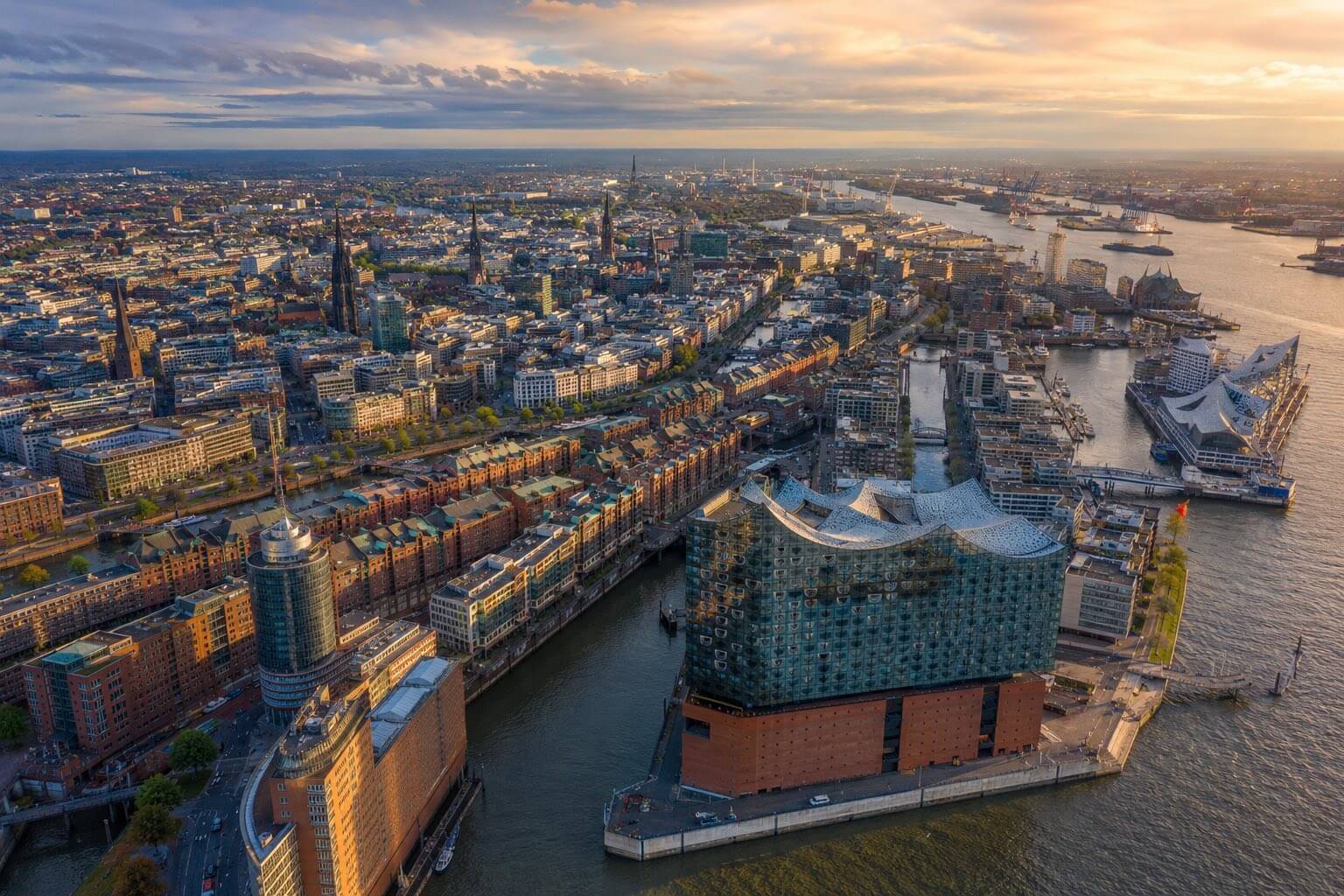
Hamburg as a retail location in figures
The foundations of the Hamburg retail market are robust. Retail-relevant purchasing power in Hamburg stands at an index of 109.5 (national average = 100). Retail centrality – the ratio of actual turnover to purchasing power potential – is 113.4 and thus clearly above the national average. Fashion centrality is particularly pronounced at 173.7: in the lead category of inner-city retail, Hamburg attracts significantly more turnover than would arithmetically be expected from its own purchasing power potential.
Total Hamburg retail turns over around 11.4 billion euros per year and offers approximately 2.68 million square metres of sales floor. The inner city concentrates around 347,000 square metres and generates nearly 2 billion euros in turnover, delivering a floor productivity of about 5,700 euros per square metre – the second-highest value among Germany’s top-7 locations, after Munich. The Hamburg metropolitan region has a total population of over five million, of whom around 1.7 million from the Schleswig-Holstein and Lower Saxony surroundings regularly commute to the Hanseatic city for shopping.
Hamburg’s prime highstreet locations
Hamburg’s inner city is structured around two central retail axes: the traditional City East with Mönckebergstraße and Spitalerstraße as high-frequency department-store and multiple-retailer streets, and City West with Neuer Wall and Jungfernstieg as exclusive luxury and premium boulevards. Between them, the Europa-Passage functions as the most significant inner-city centre. This two-axis structure is a key differentiator for Hamburg – hardly any other German city offers two complementary prime locations with clearly distinguishable target groups at such short walking distance.
Neuer Wall – luxury highstreet of international rank
Neuer Wall is one of the most significant luxury shopping streets in Europe. Between Jungfernstieg and Bleichenbrücke, international premium brands such as Louis Vuitton, Chanel, Hermès, Bottega Veneta, Ermenegildo Zegna, Giorgio Armani, Mulberry and Balenciaga line up next to each other – complemented by contemporary concepts such as Anine Bing, Isabel Marant and MCM. The Balenciaga store with 540 square metres over two floors was one of the brand’s largest store deals in Europe. Prime rents on Neuer Wall historically stand at around 275 euros per square metre for small units of 80 to 120 square metres, and at approximately 160 euros per square metre for larger units above 300 square metres. The ongoing development of the Stadthöfe and the redesign of Alsterhaus (KaDeWe Group) create further momentum in the upper segment.
Mönckebergstraße – the traditional department-store axis
Mönckebergstraße connects the main train station and Rathausmarkt and is Hamburg’s traditional department-store and multiple-retailer axis. Characteristic features are the Hanseatic red-brick architecture, large department-store space (Galeria Kaufhof/Karstadt), consumer-electronics retailers (Saturn) and international verticals such as Zara. The street reaches peak frequency of around 8,000 pedestrians per hour at Gerhart-Hauptmann-Platz in front of Karstadt. On the rental side, small units historically stand at around 215 euros per square metre, larger units above 300 square metres at around 128 euros per square metre. The Business Improvement District (BID) Mönckebergstraße has significantly upgraded the ambience with a budget of over 10 million euros, funding new LED street lighting, winter illumination and service infrastructure.
Spitalerstraße – highest frequency and floor productivity
Spitalerstraße, a pedestrian zone between the main train station and Mönckebergstraße, is Hamburg’s most frequented retail street. Around 10,000 pedestrians per hour and the highest floor productivity in the city make it the absolute prime location for mass-market retailers and multiples. Germany’s largest H&M store, the expanded NIKE flagship store and strong tenants such as Zara, ANSON’S and P&C characterise the tenant mix. Prime rents for small units historically stand here at around 310 euros per square metre, for larger units at around 190 euros. A structural feature of many units: they open onto both Spitalerstraße and Mönckebergstraße, creating dual addresses and frequency synergies.
Jungfernstieg – Alster location with boulevard character
Jungfernstieg along the Binnenalster is Hamburg’s classic promenade boulevard – with retail on one side only and a focus on premium brands, upscale concepts and a strong tourist share. Peak frequency on Jungfernstieg reaches around 6,000 pedestrians per hour at Lloyd Schuhe. The ongoing reconstruction of Alsterhaus by KaDeWe Group and the redevelopment of Haller-Haus (around 2,000 square metres of new retail space) are visibly changing the offer. Douglas has opened a new flagship of around 1,000 square metres. Prime rents at Jungfernstieg historically stand at around 200 euros per square metre for small units and 148 euros for larger units.
Arcade district and secondary locations
Between the two highstreet axes, Große and Hohe Bleichen, Poststraße, Gerhofstraße and the city arcades (Kaufmannshaus, Alte Post, Girardet Höfe, Kaisergalerie, Hanse-Viertel) function as a premium arcade district with high dwell quality. Increasingly, upscale concepts that do not seek mass-market appeal settle here. TED BAKER opened its first German store on Poststraße. Rents in the Bleichen locations and the arcade district range from 90 to 185 euros per square metre for small units.
Hamburg prime rents 2026 – stabilisation after a correction phase
Prime rents on Hamburg’s highstreet went through a marked correction between 2019 and 2023. Before the Corona pandemic, top rents in prime locations had at times exceeded 300 euros per square metre per month. Protective measures, the shift of consumption to online and several insolvencies of established retailers led to falling rents and rising vacancies. Stabilisation has been evident since 2023: Hamburg’s current prime rent stands at around 250 euros per square metre in 2026 (net cold, monthly) and is thus unchanged year-on-year.
Actually agreed rents vary strongly depending on unit size, exact location within the street, fit-out standard and lease term. For units above 300 square metres and in less frequented sections, values fall significantly below the top figures. Retailers increasingly seek flexible rent models with turnover-linked components to reduce risk – a trend clearly visible in Hamburg as well.
Investment market and prime yields
Hamburg’s investment market for retail properties is characterised by sustained strong demand meeting limited supply. Prime yields for highstreet properties in absolute top locations have – as in all German top-7 cities – shifted markedly upwards in the wake of the interest-rate turn: from below 3.0 per cent before the pandemic to around 3.7 to 4.0 per cent today. For investors with a long-term horizon, Hamburg highstreet properties therefore again offer a more attractive risk-adjusted return than during the low interest-rate years.
Prominent deals of recent years in Hamburg included the sale of Wallhaus at Neuer Wall (with luxury tenants Giorgio Armani and Mulberry) to a family office, the Burstah Ensemble development by COMMERZ REAL sold to Gator, as well as the acquisition of significant Hamburg commercial buildings within the open-ended real estate fund Hausinvest of COMMERZ REAL. The Hanseatic city remains firmly on the priority list of international investors – the waterside location, the touristic appeal and the uniqueness of the HafenCity development make Hamburg one of the few German core locations where international capital shows consistent presence.
Purchasing power, catchment area and tourism
Hamburg benefits from an exceptional catchment area. Beyond its own 1.84 million inhabitants, the sphere of influence extends far into Schleswig-Holstein and Lower Saxony. Total demand potential lies at around 3.5 million consumers with an annual retail turnover potential exceeding 22 billion euros. As an economic location, Hamburg – with GDP per capita of more than 66,000 euros – sits in the European top group. Registered employment has grown in the past five years by more than 100,000 to around 970,000 persons. The daily commuter surplus is approximately 230,000 persons – a significant additional demand for inner city and transport hubs.
Tourism delivers a further layer of purchasing power: the number of hotel overnight stays has nearly doubled over the past ten years to around 15 million per year. Some 200 cruise-ship calls with more than 800,000 passengers per year, together with Hamburg’s status as the world’s third-largest musical city after New York and London, provide demand-side impulses. Since the opening of the Elbphilharmonie in 2017, Hamburg has counted as a global cultural location and is a particularly attractive German market-entry destination for international retailers. TED BAKER, UNIQLO and Anthropologie opened their first German stores here.
Current developments and projects
The Hamburg market is currently in motion as rarely before. Several large-scale projects will shape the coming years:
- HafenCity / Überseequartier – the development by Unibail-Rodamco-Westfield covers around 80,500 square metres of new retail space and significantly expands the inner-city offer. Its effect on the leasing market and inner-city rents is closely observed.
- Stadthöfe – the mixed-use development by Quantum brings around 5,000 square metres of small-scale retail units between Neuer Wall and Alter Wall to the market.
- Hamburger Hof – comprehensive redesign by MEAG in the Jungfernstieg / Große Bleichen / Poststraße area.
- Alter Wall – the landmark development by Art-Invest creates a new hinge location between Mönckebergstraße and Rathausmarkt, with UNIQLO as the first Hamburg store.
- BID Mönckebergstraße – upgrade backed by a budget of over 10 million euros for lighting, winter illumination and services.
- BID Nikolai-Quartier and the redevelopment of Gerhart-Hauptmann-Platz and Ida-Ehre-Platz strengthen the eastern inner-city surroundings.
These developments show: Hamburg’s inner city is actively responding to structural shifts in retail. Mixed-use concepts, floor reorganisations, upgrades to public space and a selective return of international brands characterise the current market picture.
What this means for owners and investors
Hamburg remains a core location for retail properties – but the easy years are over. For owners, the decisive factor is the ability to adapt space to changing retailer requirements: smaller formats, mixed-use additions, flexible lease structures, upgrading of ground-floor zones. For investors, long-let properties with credit-strong anchor tenants on Mönckebergstraße, Neuer Wall and in the arcade district remain sought after – more opportunistic buyers find chances in repositioning objects and transitional situations.
UNIQUE RETAIL supports owners and investors in Hamburg in letting, acquisition, sale and strategic repositioning of retail properties. We work independently, with an active retailer network and reliable market data for the Hanseatic city and the metropolitan region.
UNIQUE RETAIL for Hamburg
You own, develop or are looking for retail space in Hamburg? You are evaluating a retail property investment or reviewing an existing portfolio? Talk to us about your specific situation – we will give you an independent assessment of market value, lettability and repositioning potential.
Request a free initial consultation →
References & further analysis
Frequently asked questions on retail properties in Hamburg
How high are the prime rents for retail units in Hamburg?
The prime rent in Hamburg’s prime locations stands in 2026 at around 250 euros per square metre per month (net cold) and has remained stable year-on-year. In particularly premium sections of Neuer Wall, Spitalerstraße and Mönckebergstraße, small units between 80 and 120 square metres historically achieved values between 275 and 310 euros per square metre.
Which are the most important prime locations in Hamburg?
Hamburg’s central highstreet locations include Neuer Wall (luxury/premium), Mönckebergstraße (traditional department-store and multiple-retailer axis), Spitalerstraße (highest pedestrian frequency in Hamburg) and Jungfernstieg (upscale Alster location with boulevard character). These are complemented by the arcade district with Große and Hohe Bleichen, Poststraße and the city arcades.
How high is purchasing power in Hamburg?
Retail-relevant purchasing power in Hamburg stands at an index of 109.5, clearly above the national average. Retail centrality of 113.4 and fashion centrality of 173.7 show that Hamburg attracts substantial purchasing power beyond its own potential from surrounding areas and tourism.
How large is the catchment area of Hamburg’s inner city?
The catchment area of Hamburg retail covers around 3.5 million people in the city and the Schleswig-Holstein / Lower Saxony surroundings. In the wider metropolitan region a total of more than 5 million people live. Annual retail turnover potential of this catchment area exceeds 22 billion euros.
How high are prime yields for highstreet properties in Hamburg?
Prime yields for inner-city retail properties in Hamburg’s prime locations stand in 2025/2026 at around 3.7 to 4.0 per cent. They have thus normalised significantly compared with the low interest-rate period before the pandemic, offering long-term investors more attractive risk-adjusted values again.
What role does tourism play for Hamburg retail?
Tourism delivers a significant share of demand. With around 15 million overnight stays per year, more than 800,000 cruise passengers, global standing as a musical metropolis and the Elbphilharmonie as a global cultural magnet, Hamburg attracts international visitors – and with them retailers who choose the Hanseatic city as a German market-entry location. TED BAKER, UNIQLO and Anthropologie opened their first German stores in Hamburg.
What makes Hamburg special as a retail property investment location?
Hamburg combines several factors that are unusually strongly concentrated for investors: the size and purchasing power of the metropolitan region, a polycentric centres structure with clearly profiled prime locations, high floor productivity in the inner city (around 5,700 euros per square metre), active BID initiatives upgrading public space and large-scale projects such as HafenCity that further develop the market structure. For core investors, Hamburg counts among the three most attractive German retail locations.